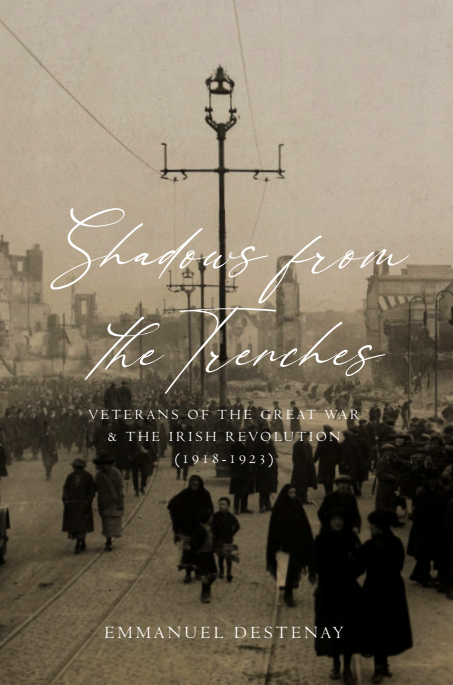



Shadows from the Trenches. Veterans of the Great War and the Irish Revolution (1918-1923)
Référence bibliographique :
Shadows from the Trenches. Veterans of the Great War and the Irish Revolution (1918-1923). Dublin, University College Dublin Press, 2021, 250 pp.
Auteur.e.s membre de l'UMR : Emmanuel Destenay (FRHistS FHEA)
Type : Ouvrage
Année : 2021
Axe(s) de recherche : 4. Temps, traces et territoires de guerre, 5.3 Guerres, violences et sexualités
Lien vers l'éditeur : Cliquez ici
Présentation :
Approximately 150,000 Irish officers and men joined the British Army during the First World War. What happened to them when they returned home? What determining role (if any) did they play? Most importantly, did they fall victims of selective revolutionary violence and face the wrath of the IRA for having fought for the British Crown in 1914-1918?
As steamers anchored in Dublin Bay and men disembarked, they began to follow different paths according to their expectations, political beliefs, and often according to the possibilities their mother-land would consent to offer them. Transfers of loyalty and transfers of military skills characterised the demobilisation of those Great War veterans. Hundreds pledged allegiance to the Irish Republican Army while thousands joined the ranks of the Royal Irish Constabulary and the British Army. After the signing of the Anglo-Irish Treaty, ex-servicemen consolidated the institutions of the new Irish Free State whereas a minority remained loyal to the idea of an Irish Republic. Those who refrained from taking an active part in the transformation of Ireland found themselves in a society plagued by unemployment and ongoing unrest. Largely forgotten in history, their stories beg to be heard.
The centenary of the War of Independence and the Civil War represents an unexpected yet welcome moment to challenge traditional narratives and shed light on the contribution of Great War veterans to the Irish Revolution. What happened in Ireland was far from being an isolated case in European history. Re-mobilisations and re-engagements of Great War veterans characterised the internal dynamics within other European countries and states undergoing post-war transformations, revolutions or civil conflicts. Drawing on archives in in England, Northern Ireland, the Republic of Ireland, and on hitherto unsolicited testimonies, Emmanuel Destenay tracks the trajectories of these shadows from the trenches, unveiling their hopes, expectations and uncertainties.
Honorable mention, James S. Donnelly, Sr., Prize for Books in Humanities and Social Sciences (American Conference for Irish Studies, 2022)
Amidst a wealth of studies from the Decade of Centenaries, this work deserves commendation for showcasing a dedication to archival research, as well as a willingness to creatively reassess traditional narratives that have shaped the stories of this period. Destenay’s compassion and clear dedication to the experiences of the Irishmen who served in the First World War, as well as the subsequent Irish War of Independence and Civil War, is noteworthy. However, the committee was also deeply impressed with the ways this work refutes normative chronologies that see wars as bounded by distinct years. By focusing on the men of Ireland whose lives were marked by organized violence, this work shows us that the frameworks imposed on global events can often obscure the richness and complexities of life for those who lived and were shaped by those events.
Reviews
Shadows from the Trenches is an important work for understanding how the Great War influenced the development of Ireland and the larger issues of the reintegration of veterans. Destenay delves into the primary sources and does an admirable job of building on the regional histories that have dealt with these issues to create an overarching study of veterans, political violence, and the complex issue of political loyalty in Ireland as a whole in the postwar era. Richard S. Faulkner, Journal of Military History (86), no. 1, 2022: 195-196.
Ce livre constitue une contribution importante à notre compréhension de la façon dont la Grande Guerre a influencé les développements politiques et sociaux en Irlande puisqu’il jette un nouvel éclairage sur les continuités cachées ou non reconnues entre la Première Guerre mondiale et le processus complexe de construction de l’État irlandais. Il se fonde sur de nouvelles sources primaires et en même temps réussit admirablement à tirer profit des études régionales afin de construire une histoire globale du sort des vétérans irlandais. Par le biais de cette approche, il parvient également à traiter de façon plus concrète la question épineuse de la violence politique pendant les années d’après-guerre. Pour cela il mérite toute notre attention. Evi Gkotzaridis, Revue historique (706), no. 2, 2023: 366-368.
Destenay’s Shadows from the Trenches will be read with profit by historians of the Irish revolution and Irish military history. It brings much rich evidence to light and is a useful contribution to the growing body of work on the revolutionary period that has appeared in recent years. Geroge Evans, Modern British History (35), no. 2, 2024: 257-259.
In his cogent and timely volume, Emmanuel Destenay offers an admirably systematic and nuanced exploration of this hghly emotive and controversial subject, which has long been crying out for a dispassionate and evidence-driven approach like this one. It is a valuable and much-needed corrective to a fascinating debate that has at times been subject to an unfortunate degree of hysteria and hyperbole. Oisin O. Drisceoil, First World War Studies (15), no. 1 (2024): 1-3.
Emmanuel Destenay has made noteworthy contributions in English and in his native French on topics such as the conscription crisis and the memory of the First World War. His 2021 monograph, Shadows from the Trenches: Veterans of the Great War & the Irish Revolution, 1918–1923, deserves special mention for its ambition, its use of a broad range of primary sources, and its deep questioning of whether an inseparable divide emerged between veterans of the world war and their home communities in Ireland. Destenay probes the experience of men confronting a very different Ireland from the one that they had left in 1914, and he offers measured assessments of debates that have simmered about attacks on and discrimination against them. Still, it is his claim that veterans of the British military were indispensable to the successes achieved by Irish forces in the War of Independence that will likely be most memorable from this important intervention. Timothy G. McMahon, Irish Studies Review (33), no. 3 (2025): 444-447.